
When a data center switch fails, an imaging system goes down, or a network node drops offline, the clock on a contractual SLA starts running immediately. Getting the replacement part moving sounds simple until you're the one managing it at scale: warehouse space across multiple regions, carrier and customs coordination, technician dispatch timing, and a dozen other moving pieces that pull attention away from running the actual business.
That's where a logistics service provider comes in. An LSP takes on some or all of those operational burdens, acting as the infrastructure behind your supply chain so you don't have to build it yourself. For OEMs in data centers, medical devices, telecommunications, and industrial automation, the stakes on choosing the right one go well beyond convenience. Uptime isn't a logistics metric to optimize; it's a business requirement written into the contracts these companies hold with their own customers, and the LSP behind them either protects that commitment or puts it at risk.
But not every logistics provider works the same way, charges the same rates, or covers the same services. Choosing the wrong one can cost you more than doing it yourself, and in mission-critical environments, that cost shows up as a missed SLA rather than just a late shipment. Choice Logistics operates specifically at this level, as a 4PL built for OEMs whose service parts programs run against uptime guarantees, not general freight or fulfillment.
This guide breaks down what a logistics service provider actually is, the different types that exist, what services they cover, and how to pick the right one for your operation.

Logistics Service Provider Explained
A logistics service provider is a company that manages the movement, storage, and handling of goods on behalf of another business. Depending on the scope of the agreement, an LSP can take charge of a single part of the supply chain, such as warehousing or freight forwarding, or it can oversee the entire process from the moment goods leave a manufacturer to the moment they reach the end customer.
The term gets used interchangeably with logistics provider, logistic service provider, and logistics supplier, but they all point to the same concept: an external company that handles logistics operations so that you don't have to.
At its core, the logistics service provider definition comes down to specialization. These companies exist specifically to move and store goods efficiently. They have the carrier relationships, the warehouse infrastructure, the technology, and the regulatory knowledge that most businesses would take years and significant capital to build independently.
It's worth noting that LSP is not a single category. It's an umbrella term that covers several different types of providers, each with a different scope of involvement in your supply chain. A small freight forwarder and a global fourth-party logistics company are both technically logistics service providers, but what they do and what they cost look very different.
Types of Logistics Service Providers
Not all logistics providers operate at the same level. The industry organizes them into categories based on how much of the supply chain they manage and how closely they work with the businesses they serve.
First-Party Logistics (1PL)
First-party logistics means a company handles its own shipping and distribution without outside help. The business owns the trucks, the warehouse space, and the entire operation. This works for large enterprises with the capital to build that infrastructure, but for most businesses, it's neither practical nor cost-effective.
Second-Party Logistics (2PL)
A second-party logistics provider is a company that owns and operates transportation assets, such as trucking fleets, rail freight carriers, or cargo airlines, and sells capacity directly to businesses. They move goods but don't get involved in warehousing or broader supply chain management. Think of a trucking company that picks up a shipment and delivers it, nothing more.
Third-Party Logistics (3PL)
Third-party logistics is the most common arrangement businesses turn to when they start outsourcing. A 3PL provider takes on a broader range of services that typically includes warehousing, inventory management, order fulfillment, and transportation. Rather than owning the freight assets themselves, most 3PL companies coordinate between carriers and clients, acting as the operational layer between manufacturer and customer.
Fourth-Party Logistics (4PL)
A fourth-party logistics provider sits above the 3PL layer. Instead of running warehouse operations directly, a 4PL orchestrates the entire supply chain on your behalf: selecting and overseeing multiple 3PLs, freight forwarders, and carriers, managing the technology layer that connects them, and coordinating global trade compliance across every market the program touches. Rather than a business managing five or six vendors that don't talk to each other, a 4PL becomes the single operating layer that runs the network as one system.
This orchestration layer is what makes a 4PL the strongest option for complex, global LSP requirements. When a service parts program spans multiple countries, multiple SLA tiers, and multiple points of potential failure, orchestration isn't a nice-to-have on top of transportation and warehousing. It's what turns a collection of vendors into a single point of accountability: one provider owns the outcome across every region and every partner, tracks performance at the order level rather than the shipment level, and resolves exceptions before they become missed SLAs, instead of a business trying to stitch together visibility from providers that don't talk to each other.
Businesses that operate across multiple regions, run mission-critical uptime commitments, or need a single point of accountability for complex global logistics are the ones that outgrow the 3PL model and move to this level.
Fifth-Party Logistics (5PL)
Fifth-party logistics is the most recent development in the space. A 5PL provider manages logistics networks at scale, typically for multiple clients at once, and relies heavily on digital platforms and data to drive efficiency across the entire supply chain. This model is still emerging but is becoming relevant for businesses that need logistics outsourcing tied to advanced technology and network-wide optimization.
In practice, most enterprise companies engage at the 4PL level, and Choice operates as a global 4PL specializing in mission-critical service parts programs.
|
Provider Type |
Core Function |
Best For |
|
1PL |
Self-managed logistics |
Large enterprises with owned infrastructure |
|
2PL |
Asset-based transportation only |
Businesses needing direct carrier capacity |
|
3PL |
Warehousing, fulfillment, transport |
Growing businesses outsourcing operations |
|
4PL |
Full supply chain management |
Complex, multi-region supply chains |
|
5PL |
Network-wide logistics optimization |
High-volume businesses with digital focus |
What Services Do Logistics Service Providers Offer?
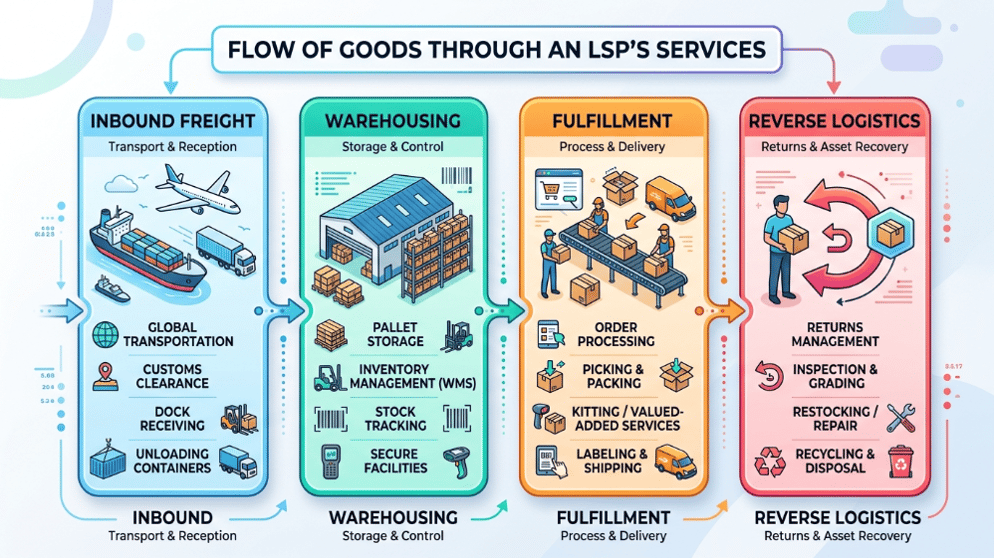
The range of services a logistics provider covers depends on the type of provider and the agreement in place. For OEMs in data centers, medical devices, telecommunications, and industrial automation, the services that matter most are the ones that keep a technician stocked and a warranty commitment intact, not just the ones that move a box from A to B. Most LSPs offer some combination of the following:
Transportation Services
Transportation services cover the physical movement of goods across different modes, including road, sea freight, air, and rail freight. Providers either own the assets directly or work with a network of carriers to find the most cost-effective route for each shipment.
Warehousing and Inventory Management
Most 3PL and 4PL providers operate warehouse facilities where client stock is stored, tracked, and managed. This includes receiving goods, organizing storage solutions, monitoring stock levels, and dispatching orders. Businesses that don't want to commit to fixed warehouse capacity or long-term leases benefit most from this arrangement.
Freight Forwarding
Freight forwarders specialize in international shipping. They coordinate the movement of goods across borders, handle the necessary documentation, manage customs clearance, and work with carriers across multiple transport modes. For businesses involved in international trade, a freight forwarder is often the first logistics partner they bring on.
Customs Compliance and Regulatory Support
International trade regulations vary significantly by country, and getting them wrong leads to delays, fines, or seized shipments. Choice Logistics runs this in-house through Global Trade Services, with 65+ importers of record and denied-party screening built into every order.
Order Fulfillment
For businesses that sell directly to consumers, fulfillment services cover picking, packing, and dispatching individual orders. This removes the need to manage packing materials, staffing, and dispatch schedules in-house.
Reverse Logistics
Returns are a reality in the mission critical service parts. Reverse logistics involves returning goods from customers, inspecting them, restocking where appropriate, and disposing of or recycling items that can't be reinstalled. A provider that handles this well can recover significant value from what would otherwise be a pure cost.
Value Added Services
Beyond the core functions, many logistics providers offer additional services such as quality control checks, product labeling, kitting, and packaging customization. These value added services matter most for businesses with specific product handling requirements or those that want to maintain brand consistency through the fulfillment process.
The Benefits of Working With a Logistics Service Provider
For most growing businesses, the case for outsourcing logistics becomes clear once the operational load starts outpacing internal capacity. The benefits go beyond convenience:
How to Choose the Right Logistics Service Provider
Picking a logistics partner is not just about who offers the lowest rate. The wrong choice shows up in late deliveries, lost inventory, poor communication, and down time. Here's what to look at before signing anything.
Define what you actually need
Before comparing providers, get clear on your own requirements. Do you need warehousing, or just transportation? Are you shipping domestically or dealing with international shipping across multiple markets? Do you have specific requirements around temperature control, fragile goods, or bulk freight? The answers narrow the field significantly, since not every logistics provider covers every service.
Check their experience in your sector
A provider that works well for an online store selling clothing may not be the right fit for a business shipping industrial equipment or perishable goods. Look for providers with a track record in your product category, since familiarity with your type of freight means fewer mistakes and better handling.
Look at their network and infrastructure
Where are their warehouses? Which carriers do they work with? A provider with a narrow network creates bottlenecks the moment your logistics needs expand beyond their coverage.
Understand their technology
At a minimum, a logistics provider should give you real-time visibility into your inventory and shipments through tracking systems you can actually use. If they can't tell you where your stock is at any given moment, that's a problem.
Ask about customs and compliance
If you move goods across borders, customs compliance is non-negotiable. Ask directly how they handle customs clearance, what documentation processes they follow, and whether they have in-house expertise or rely on third parties for this.
Assess communication and accountability
When something goes wrong, and at some point it will, you need a provider that responds quickly and takes ownership. Before committing, pay attention to how responsive they are during the sales process. Slow or evasive communication at that stage rarely improves afterwards.
Consider how the provider handles change
Large enterprise logistics providers are built to standardize. Programs get templated, and a nonstandard request or a change to an existing agreement can take a full quarter to work through committee. Specialized partners such as Choice Logistics are built to adapt instead, with program changes handled in weeks rather than quarters. For a business whose needs shift as it grows, that difference shows up fast.
Factor in ownership stability
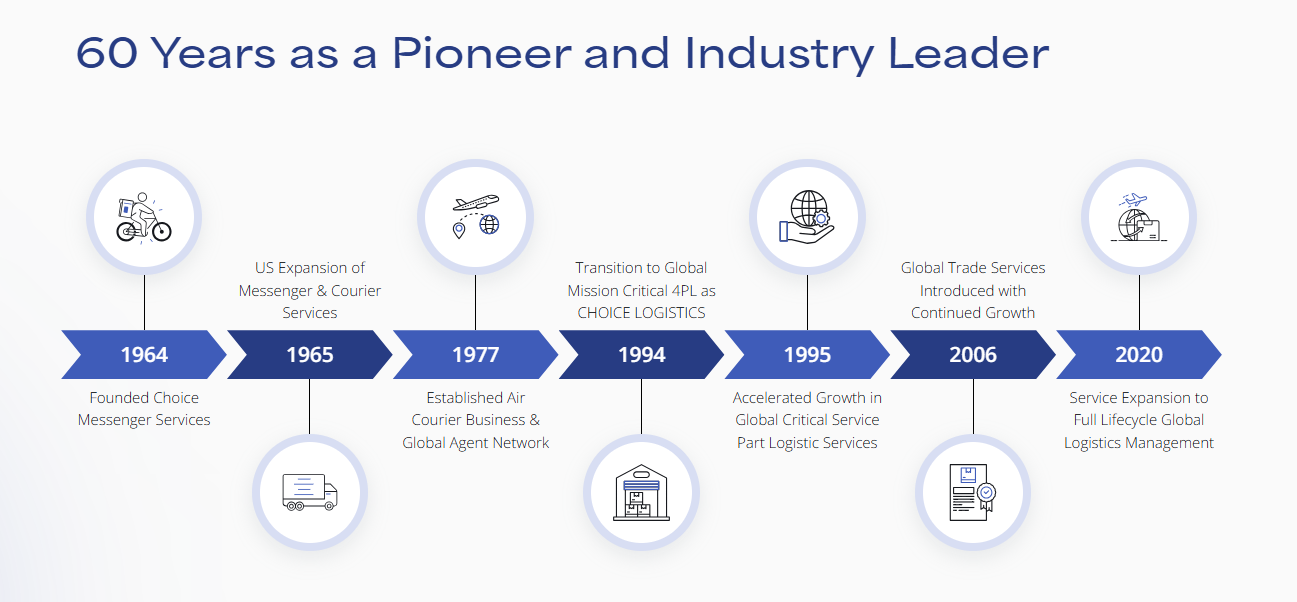
A provider's ownership structure matters more than most companies realize going in. Many logistics specialists are backed by private equity, which brings cost-cutting cycles, leadership turnover, and the possibility of a sale or restructuring mid-contract. Choice Logistics is family-owned, with 60 years of leadership continuity behind it. For a multi-year program, that stability is worth weighing alongside price and service coverage.
What to Watch Out For When Choosing a Logistics Provider
The strongest logistics partnerships are built on a few things worth confirming upfront, before you sign, so the partnership starts on solid footing rather than surprises later.
Work With a Logistics Provider That Fits Your Business
Choosing a logistics service provider is one of the more consequential decisions a growing business makes. Get it right and your supply chain runs quietly in the background while your business scales. Get it wrong and the problems compound fast.
Talk to a Choice Logistics expert about a network mapping session for your service parts program, built around where your operation runs today and where it needs to reach next.
Logistics Service Provider (LSP) FAQ's