
Warehouse management best practices are the operational standards that keep inventory accurate, orders moving and warehouse processes consistent. In a conventional warehouse, those practices improve efficiency. In mission-critical service parts logistics, they also protect service level agreements, warranty commitments and equipment uptime.
That distinction matters when a business is not managing one building, but a global network of distribution centers and forward stocking locations. A regional distribution center may receive bulk inventory and replenish dozens of FSLs. Each FSL then holds a carefully selected range of parts close to installed equipment so a technician can respond within a 2-hour, 4-hour or next-business-day service window. One incorrect receipt, missed scan or delayed replenishment can create a false stock position across the network and turn an equipment failure into an SLA breach.
That is why warehouse management practices have to work at two levels. They must make each facility accurate and efficient, while also keeping inventory, orders and replenishment synchronized across every location. Layout, scanning, cycle counting, picking and staff processes all contribute to the same outcome: putting the correct service part in a technician's hands within the promised response time.
This article explains 12 practical ways to improve warehouse operations in 2026. It covers the fundamentals expected in any well-run warehouse, then shows how those practices change when DCs and FSLs operate as one multi-echelon service network.
What Makes Warehouse Management Different in Service Parts Logistics?
General warehouse management often focuses on throughput, storage utilization and cost per order. Those measures still matter in service parts logistics, but they do not tell the whole story.
A service parts warehouse supports an installed base of equipment already operating at customer sites. Demand is triggered by maintenance, equipment failures and warranty claims rather than a predictable retail cycle. Some parts move rarely but still need to be available because the cost of not having them is high, and others may need to reach a field technician within 2 or 4 hours.
That changes how OEMs and service organizations make overall decisions. Inventory placement must reflect failure patterns, customer locations and contracted response times. Serialized parts may need condition tracking and a documented chain of custody. Returned units may require inspection, repair routing, refurbishment or disposal rather than ordinary restocking. Picking priorities must follow the delivery deadline attached to each order.
The goal is not simply to run an efficient warehouse. It is to protect uptime and help the service organization keep the promises it has made to its customers.
1.Build an Effective Warehouse Management Layout
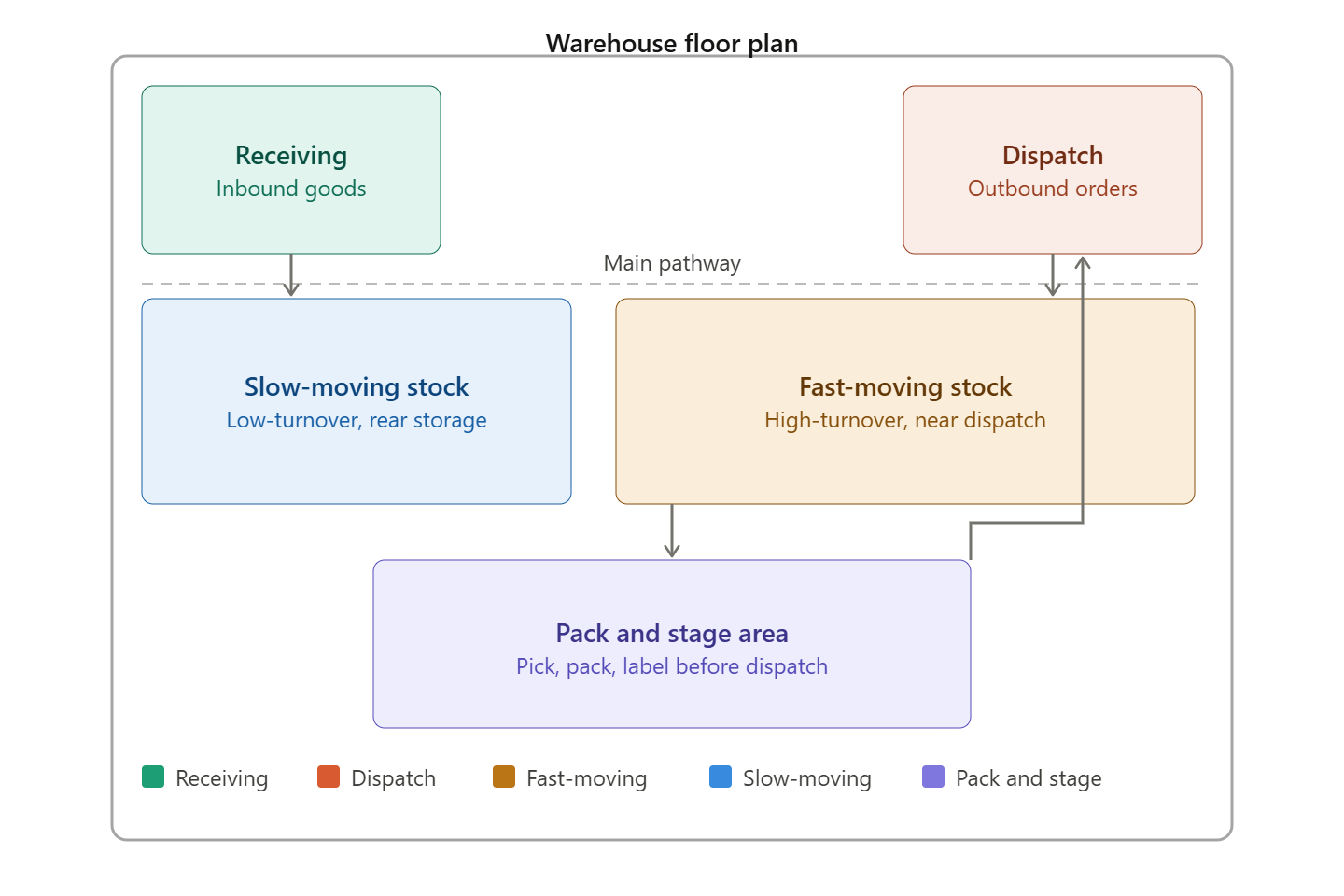 A poor warehouse layout adds time and risk to every order. When products are stored without logic, workers travel further, picks take longer and urgent orders compete with routine activity. The physical layout should reflect what the facility is expected to do within the wider service network.
Effective warehouse management starts with matching your space to the way your operation actually works. Fast-moving products go closest to packing and dispatch areas, slow-moving stock moves further back, and clear pathways keep traffic flowing without bottlenecks. Optimized aisle design keeps goods moving safely through the facility, and storage capacity stops being a problem when space is used intentionally rather than for convenience.
A well-planned warehouse layout also reduces physical strain on warehouse workers, which feeds directly into warehouse productivity and staff retention. Keeping workspaces clean and organized within that layout prevents inventory damage and reduces the risk of injury on the floor.
Small changes to storage locations can have an outsized impact on how quickly a critical part reaches dispatch.
Use Slotting and ABC Analysis
Slotting assigns each SKU to the storage location that best matches its velocity, size, weight, value and handling requirements. An ABC analysis can help separate high-activity inventory from slower-moving stock, but order frequency should not be the only consideration.
In service parts logistics, a low-volume component may still need a fast pick path if the consequence of a delay is serious. That's why warehouse layout decisions should account for both SKU velocity and the SLA or downtime risk attached to the part. High-value and serialized inventory may also need controlled access, while heavy or awkward items need safe storage and the right handling equipment.
2. Get Real Time Visibility With a Warehouse Management System
A warehouse management system is one of the most impactful investments a warehouse operation can make. Without one, teams rely on spreadsheets, manual counts, and memory, all of which introduce human error and slow warehouse processes down considerably. A WMS brings real-time visibility across stock, orders, and warehouse workflows from a single place. For an OEM weighing whether to build this capability in-house or bring in a partner who already runs it at scale, a WMS is usually where that decision starts.
The right software tracks inventory levels, manages storage locations, supports order fulfillment, and generates warehouse data that helps managers make better decisions. It connects warehouse management processes to the wider supply chain, so nothing falls through the cracks between receiving and dispatch.
Dynamic inventory visibility keeps stock levels accurate as they change in real time, rather than relying on a snapshot that's already out of date by the time someone checks it.
Improve Order Fulfillment Processes With WMS Data
A WMS also helps coordinate order fulfillment processes by directing work, validating inventory and recording each transaction as the order moves from release to dispatch. Automated systems can increase order fulfillment speed by assigning work, optimizing pick paths and confirming each step electronically. Implementing a WMS can reduce order processing errors when it replaces manual entry, paper pick lists and disconnected stock records with consistent digital controls.
The actual improvement depends on the starting process, data quality, integration, staff adoption and whether the warehouse is measuring the right result. In mission-critical service parts logistics, faster processing only creates value when inventory accuracy, serial control and SLA prioritization are protected at the same time.
Connect WMS, OMS and TMS Data
Warehouse management does not end at the loading dock. A WMS should connect with order management, transportation management, ERP and service management systems so the same transaction remains visible from order release through delivery.
This matters when a warranty claim triggers a time-critical shipment. The operation needs to identify the correct part, confirm its condition and availability, release the pick according to the SLA, select the appropriate transport service and update the field service team without rekeying information between the systems.
Choice Logistics runs this through Compass, its proprietary platform unifying WMS, OMS and TMS data across 500+ warehouse locations in 100+ countries. A dedicated team of 40+ developers supports the platform, which operates at 99.99% uptime and 85% systemic integration across client and partner systems. That availability matters because a service event can trigger an urgent part movement from an FSL at any hour and in any time zone. The network needs to see the same order, inventory and transport status throughout the transaction.
Use One Inventory Record Across Multiple Locations
Network-wide visibility should show on-hand, allocated, available-to-promise and in-transit stock across all distribution centers and forward stocking locations. This helps managers prevent stockouts, rebalance excess inventory and replenish the right location before a service issue becomes an emergency shipment.
|
Without WMS |
With WMS |
|
Manual inventory counts |
Automated inventory tracking |
|
Limited visibility across stock |
Real time visibility at all times |
|
Higher rate of human error |
Fewer errors across warehouse processes |
|
Reactive decision making |
Data-driven warehouse management |
3. Use Barcode Scanning for Inventory Tracking
Manual data collection is slow and unreliable. Barcode scanning replaces handwritten records and guesswork with fast, accurate information at every stage of the warehouse process, from receiving stock to the pick and pack process.
When warehouse workers scan items to track inventory automatically as products move through receiving, storage, and picking, stock records stay current without extra manual updates. Stock levels update instantly, discrepancies get flagged early, and the team always knows what is where. Barcode scanners are relatively low cost and integrate with most warehouse management systems, which makes it practical to implement barcode scanning so teams can confirm the right items and reduce errors.
Accurate data collection at the point of movement also means fewer mistakes reach the customer, which feeds directly into improved customer satisfaction and fewer wrong-part dispatches and higher first-time fix rates.
Track Serial Number, Lot and Condition Data
One-dimensional barcodes may be enough for straightforward SKU tracking, however two-dimensional codes can carry more information, while RFID may suit operations that need rapid, non-line-of-sight identification of multiple items. The appropriate method depends on product value, volume and handling requirements.
Item-level identification is particularly important in service parts logistics. Serial number, lot, revision and condition data may determine whether a part is suitable for a warranty repair or a regulated environment. Scanning these details at each handover creates an audit trail and reduces the risk of shipping the wrong revision or a returned unit that has not passed inspection.
4. Protect Warehouse Inventory With Cycle Counting
Traditional full inventory counts shut down operations, drain staff time, and still manage to miss errors. Cycle counting replaces that disruptive process with something far more practical. Instead of counting everything at once, warehouse teams count a portion of warehouse inventory on a rotating schedule throughout the year.
This keeps inventory control accurate without stopping the warehouse from running. High-value or fast-moving products get counted more frequently, while slower stock follows a longer cycle. Applying FIFO alongside cycle counting rotates inventory properly and prevents older stock or time-sensitive parts from sitting past their useful window.
Over time, cycle counting builds a clearer and more reliable picture of inventory accuracy than any annual count could provide, which matters most in service parts logistics where a single missed count can put uptime guarantees at risk.
Investigate the Cause of Material Variances
Correcting the inventory balance is not enough. Repeated discrepancies may point to an incorrect receiving quantity, poor labeling, an unscanned location transfer, picking error, damage or a returns process that does not separate usable and defective stock.
Use root-cause analysis to identify where the process failed, then correct the workflow, training or system rule behind it. That is how cycle counting becomes an inventory control program rather than a recurring correction exercise.
5. Improve Warehouse Productivity With the Right Picking Process
The picking process is where a significant amount of warehouse time goes, and the wrong approach wastes more of it than most warehouse managers realize. There is no single best method, but matching the picking strategy to the operation makes a substantial difference to warehouse productivity and operational efficiency. In service parts logistics, the stakes are higher than in general warehousing, since the picking method directly affects how fast a mission-critical part reaches a waiting technician.
|
Picking Method |
Best for |
|---|---|
|
Discrete picking |
One urgent, time-critical order at a time |
|
Zone picking |
Large warehouses with defined product areas |
|
Batch picking |
Multiple orders with overlapping items |
|
Wave picking |
High-volume operations with scheduled dispatch windows |
|
Pick and pack |
Smaller operations or single-order fulfillment |
In service parts logistics, the method has to flex with the SLA tier, not just order volume. A forward stocking location supporting a 2-to-4-hour SLA for data center hardware or medical imaging equipment needs a picking process built for speed and precision on single, time-critical orders, closer to pick and pack, but executed against a countdown rather than a queue. A distribution center consolidating parts kits for field service dispatch across industrial automation clients benefits more from batch or wave picking, where multiple technician orders with overlapping components move through the warehouse together ahead of a scheduled carrier pickup.
Many warehouses combine approaches depending on order volume and time of day, which gives them more flexibility without adding complexity to warehouse workflows. Voice picking technology can layer on top of any of these methods, increasing both picking accuracy and speed by guiding workers hands-free through each pick. That accuracy gain matters more when the item being picked is a serialized part tied to a warranty record rather than a generic SKU.
The right warehouse picking method reduces the time workers spend walking, cuts operational costs, and keeps order fulfillment on schedule. In a mission-critical program, "on schedule" is the difference between hitting an SLA and triggering a penalty.
6. Track Warehouse Performance With the Right KPIs
Without data, supply chain and service operations leaders are guessing. Key performance indicators turn gut feeling into measurable fact and give teams something concrete to work toward. The right KPIs surface problems early, track warehouse performance over time, and show exactly where operational efficiency is being lost across warehouse processes.
The metrics worth tracking vary by facility and service program. DCs need measures covering inbound flow and replenishment, while FSLs need measures showing whether locally held stock can support urgent field demand. The following KPIs connect warehouse activity to network and service outcomes:
|
KPI |
What It Measures |
Why It Matters |
|
Inventory accuracy |
Physical inventory compared with system records |
Confirms whether stock can be trusted when an order is released |
|
Dock-to-stock time |
Time from receipt to available inventory |
Shows how quickly inbound stock becomes usable |
|
Put away accuracy |
Items placed in the correct storage location |
Prevents lost stock and avoidable picking delays |
|
Pick and order accuracy |
Correct items and quantities fulfilled |
Protects first-time fix rates and reduces returns |
|
Order cycle time |
Time from order release to dispatch |
Identifies delays inside warehouse workflows |
|
On-time dispatch |
Orders released before the required cutoff |
Supports timely delivery and SLA attainment |
|
Inventory turnover |
How often inventory is used and replenished |
Highlights excess stock and changing demand |
|
Cost per order |
Labor and handling cost per fulfilled order |
Tracks operational efficiency without ignoring service quality |
|
Exception resolution time |
Time taken to resolve blocked orders or discrepancies |
Measures whether the team can recover before an SLA is missed |
KPIs need to be reviewed regularly, shared with the team, and tied to action. When warehouse performance data is visible and acted on consistently, it helps managers run a successful warehouse, meet customer expectations under service contracts and identify weaknesses before they cause an SLA failure.
Live order management with proactive exception resolution and 24/7 control tower oversight helps teams identify blocked orders, inventory discrepancies and transport risks early enough to protect the required service window.
Connect Warehouse Performance to Service Outcomes
Review performance by site, customer, product family, order type and service level because network averages can hide a weak location or recurring process failure. In service parts operations, warehouse measures should also connect to SLA attainment, technician readiness, first-time fix rate and equipment uptime. That shows whether an efficient warehouse is creating a better customer outcome.
7. Train and Manage Warehouse Employees Properly
Warehouse workers execute every process and follow every procedure, which means knowing how to manage warehouse employees well is a direct operational decision, not a secondary concern. The way warehouse staff are trained and managed determines how consistently good warehouse practices are followed on the floor.
New staff need structured onboarding that covers health and safety, equipment use, and warehouse workflows before they work independently. Experienced workers benefit from refresher training when processes change and from clear feedback on their warehouse performance. Cross-training across receiving, picking, packing and cycle counting builds a more flexible workforce that can absorb absence or a demand spike without missing an SLA, and a labor management system (LMS) can help plan and track that coverage. Knowing how to manage warehouse workers means setting expectations clearly, addressing issues early, and recognizing good work consistently.
High staff turnover is one of the most disruptive and costly problems a warehouse can face. A team that feels supported, informed, and fairly managed stays longer, works more carefully, and contributes to more stable warehouse operations overall.
Employee Performance and Safety
Training certifications reduce injury risk and safety violations by confirming that warehouse employees can use forklifts, lifting equipment, automated systems and other workplace machinery correctly. Certification should also match the equipment and responsibilities assigned to each role, with competency checks and refresher training when processes or technology change.
Lifting equipment reduces the manual strain involved in receiving, storing and dispatching heavy or awkward service parts, helping lower injury risk and compensation claims. Regular safety seminars reinforce safe handling, traffic routes, equipment checks and incident reporting across every shift and location.
Use Standard Operating Procedures Across Every Shift
Document clear SOPs for receiving, inspection, put away, location transfers, cycle counting, picking, packing, dispatch, returns and exception handling. Each process should identify the required system transaction, scan point, quality check and escalation route.
Safety and ergonomics are also part of operational efficiency. Suitable lifting equipment, safe traffic routes, clean work areas and well-positioned storage reduce injuries, physical fatigue and inventory damage. Across multiple locations, common SOPs help prevent service quality from changing simply because a part is stored in another facility or country.
8. Use Demand Forecasting to Strengthen Supply Chain Management
Excess inventory ties up capital and storage space. Too little stock leaves field service technicians without the parts needed to complete a repair. In service parts logistics, a stockout at a forward stocking location puts an SLA commitment at risk and can leave a technician idle while a mission-critical part is expedited in from elsewhere.
By analyzing historical outbound order data, part failure rates, and seasonal trends across the network, directors of global logistics and service parts planning teams can build accurate inventory forecasts across multiple echelons instead of relying on reactive replenishment. Setting a realistic safety stock level and reorder point for each SKU and location, informed by lead time and demand variability, is what turns that forecast into a working replenishment rule rather than a static spreadsheet.
Forecast Service Demand, Not Just Sales
Historical demand should be assessed alongside the installed base, product age, maintenance schedules, supplier lead times and customer locations. A new product launch and an aging installed base create different spare parts requirements even when their current order volumes look similar. Because service demand can be intermittent, a simple average may not provide an accurate inventory forecast.
The demand signals also differ by industry. Data center and cybersecurity hardware programs may need local coverage for high-impact component failures. Medical device networks may need to account for installed equipment, planned maintenance and strict part identification. Telecommunications, robotics and industrial automation programs may see demand cluster around particular assets, sites or equipment generations. Forecasting has to reflect the service network being supported rather than applying the same stocking rule to every SKU.
Most modern inventory management software includes forecasting tools that flag when replenishment between distribution centers and forward stocking locations needs to begin before stock runs out, and when excess inventory is building up at a location before it becomes a drain on carrying cost.
Good forecasting is what makes SLA attainment and inventory efficiency compatible goals instead of a tradeoff. When stocking levels at each FSL are tuned to actual demand and failure patterns rather than guesswork, the network holds enough of the right part in the right place to hit SLA commitments consistently, without carrying the cost of excess or obsolete inventory sitting unused in the field.
For a medical imaging provider, that may mean positioning a critical replacement component within the contracted response window without duplicating slow-moving inventory at every location. For a data center, networking or cybersecurity hardware provider, it may mean holding the components most likely to restore service close to major customer clusters. In both cases, demand forecasting protects uptime while controlling the cost of safety stock.
Set Replenishment Rules by Location
Define minimum and maximum inventory levels, safety stock and reorder points for each distribution center and forward stocking location. Replenishment triggers should account for usage, lead time, inbound variability and the service level supported by the location. The same data should also identify aging or excess inventory that could be repositioned elsewhere in the network.
9. Improve Your Warehouse Receiving Process
Everything that enters a warehouse starts at receiving, and mistakes made there travel through the entire operation. Mislabeled stock, unrecorded deliveries, and damaged goods that go unchecked create problems that are far harder to fix further down the line. Warehouse receiving best practices focus on accuracy and speed at the point of entry.
A clean receiving process means inventory data is accurate and synchronized from the start across every location in the network. The item, quantity, serial number, condition and storage location recorded at receipt must match what planners, service teams and field technicians see elsewhere in the system.
Use System-Directed Put away
System-directed put away assigns stock to a location according to available capacity, product characteristics, velocity and compatibility. Scanning both the item and destination confirms the movement and reduces misplaced inventory.
FIFO may be appropriate where older stock should move first. FEFO, or first-expired-first-out, is more suitable for products with expiration dates, whereas serialized service parts may require different storage rules based on revision, warranty status or condition.
Treat Returns as a Controlled Inventory Flow
Returned service parts should enter a separate inspection and disposition process. Record the reason for return and confirm identity, condition and completeness. The item may then return to available inventory, move to quarantine, go to a repair depot, enter refurbishment or proceed to responsible disposal.
Advance exchange programs make this especially important because the replacement moves outbound before the failed unit returns. Linking both transactions preserves asset visibility and helps recover value without allowing defective stock back into circulation. Learn how Choice Logistics coordinates returns, repair, refurbishment and recovery through its reverse logistics solutions.
That synchronization is essential across Choice's core industries. A medical device technician cannot complete a first-time fix if the required component is shown as available but is damaged or in the wrong location. A data center, telecommunications or cybersecurity hardware team may lose valuable response time if an incorrect receipt creates a false stock position. A robotics, industrial automation or energy technology program may then need an unnecessary emergency shipment from another market. Accurate receiving prevents technician delays, reduces expedited shipping and protects first-time fix rates across the global service network.
10. Reduce Walking Time to Improve Warehouse Workflows
In a busy warehouse, travel time adds up fast. Workers spend a significant portion of their shift simply moving between locations rather than picking, packing, or processing orders, and that time does nothing for warehouse productivity or operational efficiency.
The most effective ways to cut unnecessary movement come down to warehouse layout, organization, and picking strategy working together. Fast-moving products stored close to dispatch, logical slotting of related items, and picking routes that minimize backtracking all reduce the distance warehouse workers cover without changing how hard they work. Warehouse management software can generate optimized pick paths automatically, which removes the guesswork from route planning entirely.
Even modest reductions in the time workers spend walking translate directly into more orders fulfilled per shift, lower operational costs, and less physical fatigue across the team.
Design Travel Around the Urgency of the Service Network
The best layout will differ between a regional distribution center and a forward stocking location. A distribution center supporting scheduled replenishment may use zone or wave activity to move larger volumes efficiently, and a forward stocking location supporting a two-hour or four-hour response for medical, data center or telecom equipment needs a compact and predictable route to its most critical inventory.
Map each handoff between receiving, storage, picking, packing and dispatch. Keep a touch when it verifies identity, condition, compliance or chain of custody. Remove it when it only repeats data entry or moves inventory between poorly arranged work areas. The objective is to shorten the route to a correct dispatch, not simply ask warehouse employees to work faster.
11. Automate Warehouse Processes Where They Protect the SLA
Automation gets talked about as if it is an all or nothing investment, but most warehouses benefit from starting small and scaling from there. Automated storage and retrieval systems, conveyor belts, and label printing automation all reduce human error and free warehouse workers up for tasks that need human judgment rather than repetitive manual effort.
The warehouse processes that benefit most from automation technologies are the ones that are repetitive, high-volume, and error-prone. Barcode scanning at receiving, automated replenishment processes triggered by inventory levels, and software-driven pick lists are examples of automation that do not require a complete overhaul of existing warehouse workflows.
Technology in Warehouse Management
Automated storage systems can recover wasted space by using vertical capacity and reducing the floor area required for fixed aisles. Automated storage and retrieval systems can also improve storage density, but the achievable improvement depends on the existing layout, SKU dimensions, throughput, access requirements and the type of system installed.
Pick-to-light technology increases picking accuracy by directing warehouse workers to the correct storage location and confirming the required quantity. It can be particularly useful in high-volume picking areas, although barcode validation, accurate inventory data and exception controls remain necessary when serialized or warranty-controlled service parts are involved.
Before investing, map out where time is being lost and where equipment failures or errors are most frequent. Automation works best when it solves a specific, well-understood problem, and the return on investment becomes far clearer when the operational cost of the problem is already known.
Match Automation to the Mission-Critical Use Case
A high-volume distribution center may justify conveyors, automated storage and retrieval or automated packaging. A lower-volume forward stocking location may gain more from reliable scan-led controls, automatic replenishment triggers and SLA-based task prioritization. The right level of automation depends on order profile, product value, handling needs and the consequence of delay.
Document what happens when equipment, connectivity or an integration fails. Medical device, data center, telecommunications and industrial automation orders still need a controlled route to dispatch when the primary workflow is unavailable. Any manual intervention must be recorded and reconciled with the WMS when normal service resumes.
12. Use Data Collection to Drive Continuous Improvement
The warehouses that run best over the long term are not the ones that did a big overhaul once. They are the ones where warehouse managers and workers treat improvement as an ongoing part of the job rather than a one-off project. Proper warehouse management means reviewing processes regularly, acting on KPI data, and making adjustments before small inefficiencies become costly ones.
Good data collection gives managers valuable insights into where time is being lost, where errors are clustering, and which warehouse management processes are underperforming. Without that data, decisions are based on assumption rather than fact, and problems tend to grow quietly until they become expensive.
When warehouse employees are encouraged to flag inefficiencies and contribute ideas, the operation benefits from ground-level insight that managers rarely see from a distance. That kind of engagement builds a more invested and stable team, which feeds back into every other best practice on this list and supports more efficient warehouse operations across the board.
Use Audits and Root-Cause Analysis Across the Network
A missed dispatch is an outcome. The cause may be inaccurate inventory, delayed put away, poor slotting, an integration failure or an exception that reached the wrong person. Regular audits should sample physical inventory, scan compliance, SOP adherence, access controls, shipping documentation and exception records.
Review those findings by site, customer, industry, part family and SLA tier. A recurring issue affecting serialized medical parts may need a different response from a replenishment delay affecting telecom hardware or a picking issue involving a robotics component. The same operating standards should apply globally, but corrective action needs to address the actual failure mode.
Choose a specific problem, establish the baseline, make one controlled change and measure the result. If the change works, standardize it across the relevant locations. If it does not, use the evidence to test another approach.
How the Warehouse Management Processes Work Together
The practices above are connected. Receiving creates the inventory record. Put away determines whether the item can be found. Slotting influences picking speed. Scanning confirms each movement. Cycle counting tests whether the system can be trusted. Demand forecasting and replenishment place inventory where future service events are most likely to occur. Picking and dispatch then convert that planning into an SLA result.
For mission-critical service networks, improving only one stage can move the bottleneck rather than remove it. Effective warehouse management uses shared data and consistent controls from inbound receipt to technician delivery and return, regardless of whether the part supports medical equipment, data center infrastructure, telecommunications, cybersecurity hardware, robotics, automation or energy technology.
Why Inventory Accuracy Cannot Be Aspirational
In most warehouse operations, inventory accuracy is treated as a target worth striving toward. In mission-critical service parts warehousing, that framing does not hold up. Choice Logistics maintains 99.9% inventory accuracy across its network, and in this environment that standard can't be aspirational.
A missed count in this environment is not a minor discrepancy to correct on the next cycle. It can mean an SLA breach, a warranty compliance failure, or equipment sitting down at an end customer's site while a technician waits on a part that the system says is there but isn't.
This is where Choice's 4PL model matters. Compass, its proprietary platform coordinates inventory, technology, transportation, replenishment, and service performance across DCs and FSLs as one connected operation. That gives clients a single point of accountability for inventory accuracy and SLA attainment across the wider network, rather than measuring success only by the cost of an individual warehouse.
Every best practice covered in this article, from cycle counting to receiving accuracy, exists in service parts logistics for that exact reason: to protect SLA attainment and the uptime guarantees a client has already made to their own customers.
Final Thoughts
Good warehousing practices do not come from fixing one thing and moving on. They come from building systems that work together, measuring what matters, and making steady improvements over time. The 12 warehouse management best practices covered in this article address the areas where most operations lose time, money, and accuracy, from warehouse layout and inventory tracking all the way through to data collection and staff management.
Warehouses that invest in the right software solutions, train their people properly, and use real data to guide decisions consistently outperform those that rely on outdated methods. The result is more efficient warehouse operations, lower avoidable handling and expedited transport costs, more reliable SLA performance, and a service supply chain that holds up under pressure.
A single warehouse and a multi-echelon service-parts network do not operate in the same way. Both require accurate transactions, disciplined processes and measurable improvement, but service-parts networks must also coordinate inventory, replenishment and order priority across DCs and FSLs according to SLA risk. Start with the constraint causing the most friction, correct it, measure the outcome and then apply the learning wherever the same failure mode exists across the network.
At Choice Logistics, we run mission-critical service parts warehousing built for SLA attainment, not just storage. Interested on optimizing your service parts program?